
John’s cancer journey didn’t begin with a diagnosis; it began with uncertainty.
In November 2024, while visiting his son for an early Christmas, he had a catheter put in. A few weeks later, it was removed. By early January, he was back in emergency, unable to urinate. That’s when things shifted. His urologist, direct, but calm, told him they needed to proceed as if it was cancer.
“Let’s go with this is cancer,” he said.
Not long after, John was introduced to VCDS.
At first, he wasn’t sure he needed it. He could still drive. He had always been independent. He lived close enough to his GP and urologist that he often walked, 20 to 25 minutes each way. Even as appointments increased, blood work, scans, follow-ups, he kept moving, pushing himself to stay active.
“I’d slow down a bit on the way home just to keep my heart rate up,” he says. “That was my exercise.”
But treatment changed things.
Radiation itself was quick, just three minutes in the machine, but everything around it wasn’t. Appointments were scheduled for 15 minutes. Travel, parking, waiting, it all added up. And then came the side effects.
“They told me two to three weeks before anything hit,” he recalls. “For me, it was day eight. Not even two weeks in.”
The fatigue. The urgency. The unpredictability. Suddenly, getting to and from treatment wasn’t just inconvenient, it was overwhelming.
“That’s where the service really took a load off my mind,” John says. “I could focus on getting better instead of fighting traffic, worrying about parking, or whether I’d have to walk too far when I wasn’t feeling well.”
His first ride didn’t go smoothly.
He had an appointment at VCC that was supposed to take an hour and a half. It stretched to nearly three. Sitting there, knowing a volunteer driver was waiting, weighed on him.
“I felt terrible,” he says. “I kept thinking, they’re doing this for me, and I’m keeping them.”
He eventually apologized to the driver. But what stayed with him was the patience.
After that, things found their rhythm.
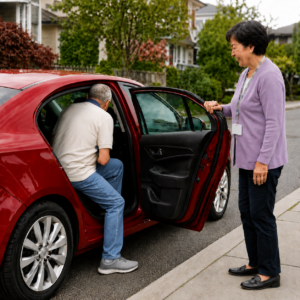
Drivers were consistently on time, or early. Communication was clear. He’d get a call confirming his ride, then another from the driver within 24 hours, sharing pickup details and even the licence plate so he knew exactly who to expect.
“Very professional. Very courteous,” he says. “You always knew where things stood.”
The rides themselves were easy. Conversations, when they happened, were natural, about life, about Richmond and how it’s changed, sometimes even about shared experiences with cancer. A few drivers had been through it themselves.
“Everyone was friendly. Easy to get along with.”
There were small moments that stood out. A driver delayed by tunnel traffic who still made it work. Another who preferred to stay focused on the road during busy conditions. A system that, overall, just worked.
And for John, that reliability mattered, especially during a stretch of about 20 days when he needed consistent support.
Without VCDS, he likely would have relied on taxis. He’d done that before, short rides in Richmond, about $12 each. But daily trips, back and forth, while managing treatment side effects? That would have added up quickly, financially and physically.
His family, while supportive, wasn’t close by. His daughter’s family lives in Las Vegas, three grandsons, born in 2022, 2024, and 2026, keep her busy. His son lives in Calgary. They couldn’t be there day-to-day.
“You came to the rescue,” he says simply. “It let me focus on the disease and the symptoms, not everything else around it.”
When he reflects on the experience as a whole, his perspective is clear.
“Not really anything major to change. The system works well.”
In fact, it’s left a lasting impression.
On some level, John says he felt a bit guilty, having someone drive him all that way for such a short treatment.
But that feeling has shifted into something else: appreciation, and a desire to give back.
“If my cancer is cured, or even if it isn’t, I’ve thought about becoming a volunteer driver myself.”
Because for him, that’s what VCDS represents.
Not just a ride.
But a steady, reliable presence during one of the most uncertain times in his life.